


Booker T. Washington in Iowa: Iowa Time Machine February 2, 1899
- Feb 2
- 2 min read

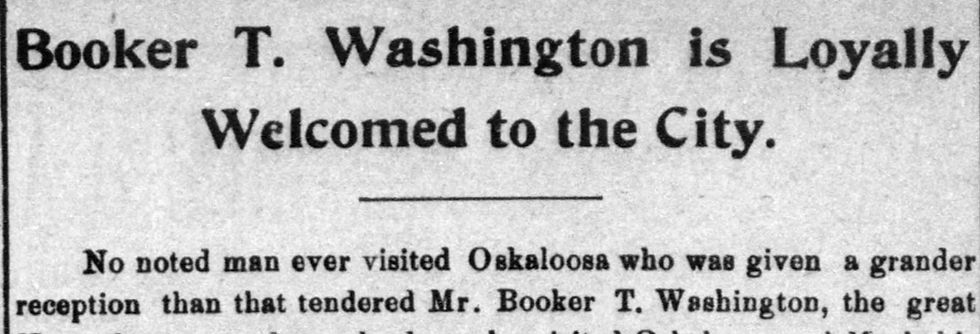
Iowa Time Machine ⏰: On February 2, 1899, the nation’s most prominent Black educator, Booker T. Washington, spoke in Oskaloosa and Muchakinock, Iowa. The visit to the south-central Iowa coal mining town that served as a forerunner to the far-famed Buxton allowed Washington to witness something he rarely saw elsewhere in America: a thriving, integrated community where African American miners earned the same wages as their white counterparts and lived without the suffocating restrictions of Jim Crow.
The late 1890s marked a dark period for African Americans across the nation. The Supreme Court's 1896 Plessy v. Ferguson decision had legitimized "separate but equal" segregation, and Southern states were systematically stripping Black citizens of their voting rights through poll taxes, literacy tests, and violence. Washington had emerged as the most influential Black leader in America following his 1895 address at the Atlanta Exposition, where he urged African Americans to accept segregation temporarily while focusing on economic advancement and industrial education. The Tuskegee Institute, which Washington had built into a premier vocational school in Alabama, stood as his answer to racial oppression: education, self-sufficiency, and economic progress would eventually earn Black Americans the respect that political agitation could not.

Washington's speech in Muchakinock drew hundreds of residents to hear him discuss education and economic opportunity. The Consolidation Coal Company established Muchakinock in the mid-1890s, recruiting Black miners from the South and Virginia, creating a company town where roughly half the 5,000 residents were African American. The town featured Black doctors, lawyers, business owners, and even a Black company superintendent. Washington toured the community's facilities, including its schools, where Black and white children learned together. It spoke to an audience that embodied his vision of what Black economic success could achieve. The visit energized Muchakinock's residents, who saw in Washington's message an affirmation of their own accomplishments.

Eventually, Muchakinock’s residents moved to form the nearby town of Buxton as coal deposits gave way. Buxton’s story took a tragic turn in the 1920s, when the mines closed and the town gradually disappeared, with its buildings moved or demolished and its residents scattered. Today, only a few foundations and memories remain of the vibrant community that once stood here. Washington left Muchakinock encouraged by what he saw, carrying the story of this Iowa town back to audiences across the country as proof that his patient, economic approach could work. However, the fate of the communities showed that much work remained to be done. #Iowa #OTD #BlackHistory #Learning #History


Comments